
What New Kent County Property Tax Records Show
Assessment and collection live in separate systems in New Kent. The Commissioner's Vision data and the county land-book material cover the current owner, sale date and price. They also cover assessed value, construction, square footage, acreage, zoning, and district. Bills are different. The Treasurer's system holds each bill, the payment history, and the tax history. It also covers the delinquent-balance route. One caution applies. The county's property-data description does not expose a live sample of every exemption or parcel-card field, so confirm a specific classification or relief entry with the Commissioner instead of assuming a generic tax card label exists.
| Field | What It Shows | Where |
|---|---|---|
| Assessed value | Value on the Commissioner’s 2026-effective assessment record | Vision; county Excel and land-book files |
| Sale information | Reported sale date and price; confirm the recorded transaction | Vision and county transfer data |
| Land and improvements | Construction details, square footage, acreage, zoning, and district | Commissioner of the Revenue |
| Bill and payment status | Amount billed, payment history, tax history, and balance | Treasurer portal |
| Relief and land use | County-administered land-use programs and qualifying relief | Ask the Commissioner about parcel-specific entries |
Three figures get confused constantly. A sale price describes a transfer. An assessed value is the county's valuation record. The bill applies the relevant rate and account details to that value. New Kent's published 2026 equalized rate is a countywide comparison figure, not a parcel-specific calculation. For an actual bill, use the Treasurer's account system. For value or parcel characteristics, use the Commissioner's portal.
Find a New Kent Tax Bill and Payment History
The Treasurer's portal switched systems in October 2025, and the county issued new account numbers. Quick Payment requires the tax account number. An old bill number may not locate an account after the transition. Through the portal you get account login, payment history, and tax history. You do not get the general assessment source there. For value and property-description questions, follow the portal's direction to VGSI or contact the Commissioner.
- Locate the tax account number from a current bill or ask the Treasurer if an older account reference does not work.
- Use New Kent’s online portal to open the account or make a quick payment, then check payment and tax history.
- Use e-check if appropriate; the county lists e-check as free and card payment as carrying a convenience fee.
- Call the Treasurer to confirm a delinquent balance or tax-sale question; online payment status is not a title record.
- Assessed value
- The Commissioner’s parcel valuation used in the assessment record; it is distinct from a sale price.
- Equalized rate
- A countywide comparison rate published with the 2026 reassessment; do not treat it as a parcel bill.
- Tax account number
- The identifier used by the Treasurer’s billing portal; New Kent issued new numbers in October 2025.
- Tax lien or delinquency
- An unpaid-tax issue that must be confirmed with the Treasurer and, when recorded, the Clerk.
Review a New Kent County Assessment
New Kent's 2026 reassessment took effect January 1, 2026. The county offers a Commissioner review path. It also offers a Board of Equalization process with appeal forms and hearing information. For that cycle, the published Board deadline was 4:00 p.m. April 30, 2026, with hearings in June. That filing deadline has passed. Anyone preparing a later request should check the current Commissioner and Board instructions. Do not rely on a prior year's date.
The county's appeal guide sets a concrete rule for comparable-sale evidence. Use sales within one year before the assessment effective date. Distinguish qualified "Q" sales from unqualified "U" transfers in the county database. An unsold listing is not a comparable sale. Keep the parcel number, assessment record, sale references, and any building or acreage correction together. That keeps a factual-data issue separate from a disagreement about value.
2026 deadline passed. The Board’s published deadline for the 2026 appeal was April 30 at 4:00 p.m. Check the current Board of Equalization page and the Commissioner before planning a later appeal.
New Kent Commissioner and Treasurer: Two Jobs
The Commissioner of the Revenue administers real-estate identification and assessment. That office handles parcel creation, transfers by deed, will, or gift, tax maps, land books, land-use programs, elderly and disabled relief, and disabled-veteran exemptions. Its real-estate phone is (804) 966-9611, and Room 202 sits at 12007 Courthouse Circle. The Treasurer maintains the tax account, the bill, payments, and delinquency information. The Treasurer is reachable at (804) 966-9615 at the same courthouse address.
Split your questions accordingly. Use the Commissioner when the owner, acreage, building details, land classification, or assessment needs review. Use the Treasurer for an account balance, payment posting, tax history, or bill date. The county explicitly directs general assessment questions to VGSI rather than the tax-payment portal. Keep the two sources and their identifiers separate. Do this when comparing a 2026 parcel value with a paid tax bill. The Vision assessment portal is the county's working source for property data.
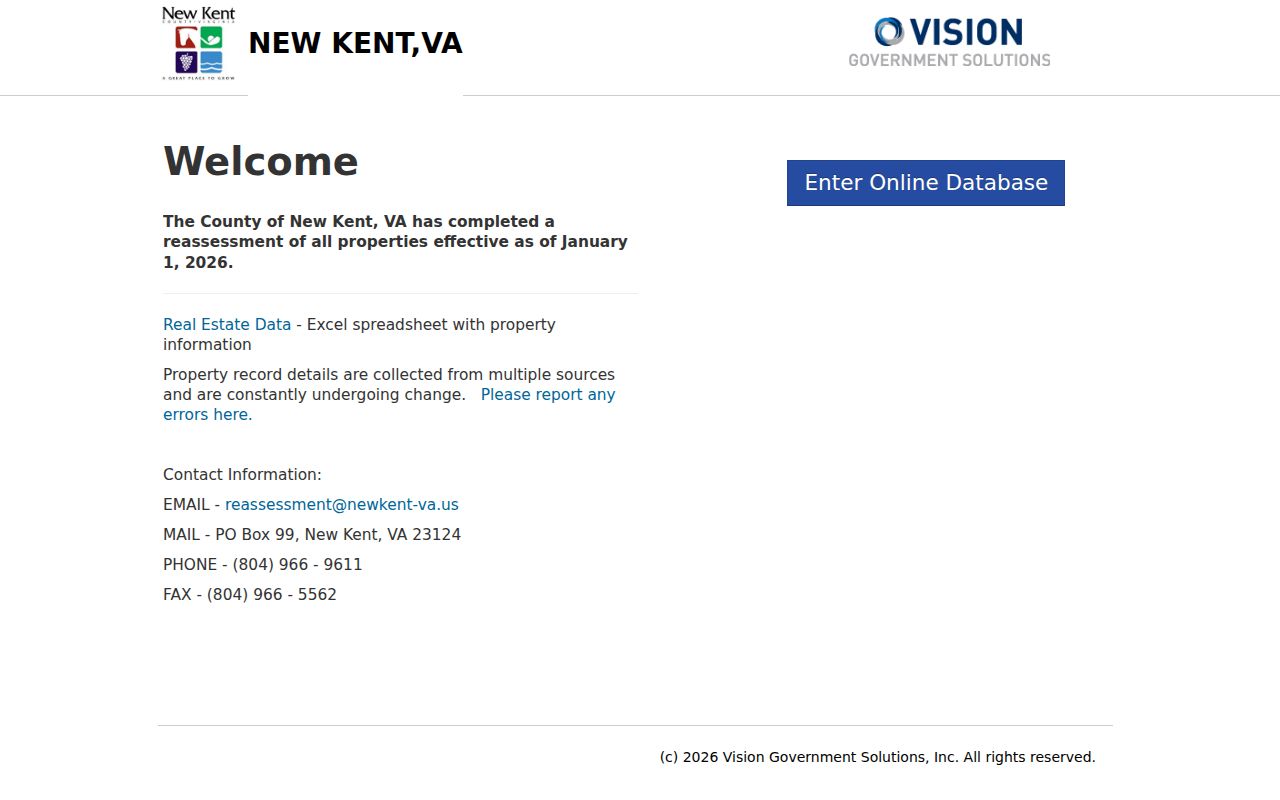
This view covers assessment information only; bill and payment status live in the Treasurer's system.
Read New Kent’s January 1, 2026 Assessment
The 2026 New Kent reassessment is effective January 1, 2026. The Vision database is updated weekly. Do not confuse the assessment's effective date with the Treasurer's billing year or account number. The county's reassessment materials include a guide, manuals, rate files, qualified-sales material, appeal forms, and Board of Equalization dates. When saving a comparison, retain the parcel identifier, the file date, and the effective date. Also record whether a sale was marked qualified.
New Kent estimated the countywide fair-market value of taxable and exempt real estate at $7,684,716,390. It also reported a 2026 equalized rate of $0.54 per $100 of assessed value. That is useful county context. It is not one parcel's tax bill. It also cannot tell whether a specific building characteristic or exemption is correct. Use the individual parcel record for the assessment. Use the Treasurer's account for the amount actually billed. Open the 2026 reassessment instructions for the official materials.
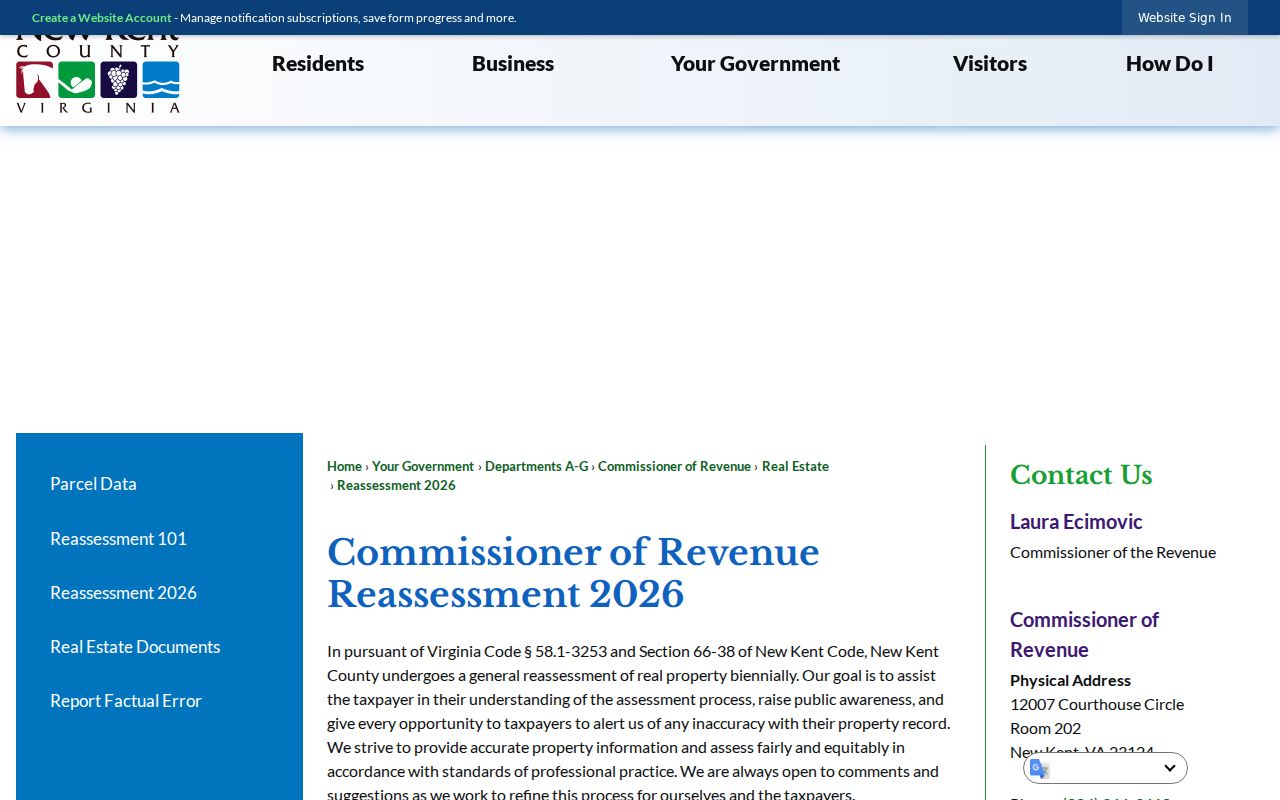
The county page groups the effective-year guidance and supporting assessment resources.
Use Transfer Data Carefully in a Tax Review
Filtering is where a tax review starts. New Kent's Vision sales filter page lets you narrow transfers by date, price, land area, building area, model, and style. The countywide file pairs each reported sale date and price with assessment data. It also adds property characteristics. That mix makes it easier to line up properties similar to your own. It does not make every transfer a usable comparable. Gifts, estate transfers, and other unqualified transactions sit in the same file. They can distort a value argument fast.
The 2026 appeal guidance sets a tighter standard. Qualified sales should fall within the year before the effective date. They should carry the county's "Q" designation, not "U." A listing without a completed sale proves nothing about value. Note: Save the filter settings you used before asking the county to reconsider, and verify each candidate's deed, sale details, acreage, and building data.
Find candidates with the controls first. Then confirm qualified status and sale context before leaning on any single comparison.
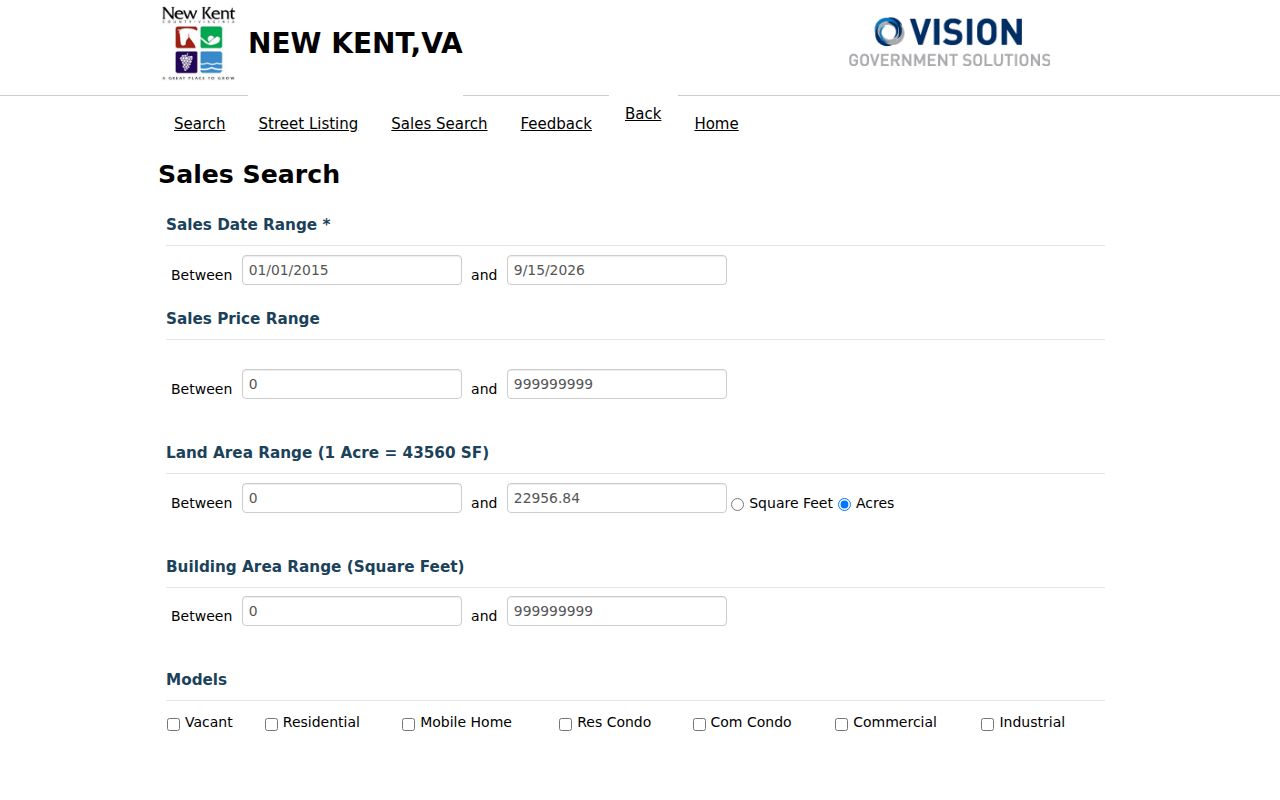
Use these controls to find candidates, then confirm qualified status and sale context before relying on a comparison.
New Kent’s 2026 Board Appeal Calendar
New Kent's Board of Equalization set 4:00 p.m. on April 30, 2026 as the filing deadline for a 2026 appeal, with hearings scheduled in June. That date has now passed. Treat it as a historical marker tied to the 2026 reassessment alone. For the next review period, application requirements, and hearing calendar, check the New Kent Board of Equalization page or contact the Commissioner.
The Board route fits inside a larger sequence. Start by deciding whether your concern is a factual record error or the county's opinion of value. Then work through the Commissioner's data, the reassessment guide, and the comparable-sale material. Follow whatever filing route is currently published. A dispute about a payment posting belongs with the Treasurer instead.
The county also names a court-appeal route. Legal deadlines and evidence rules there should come straight from current official instructions, since those shift and carry real stakes.
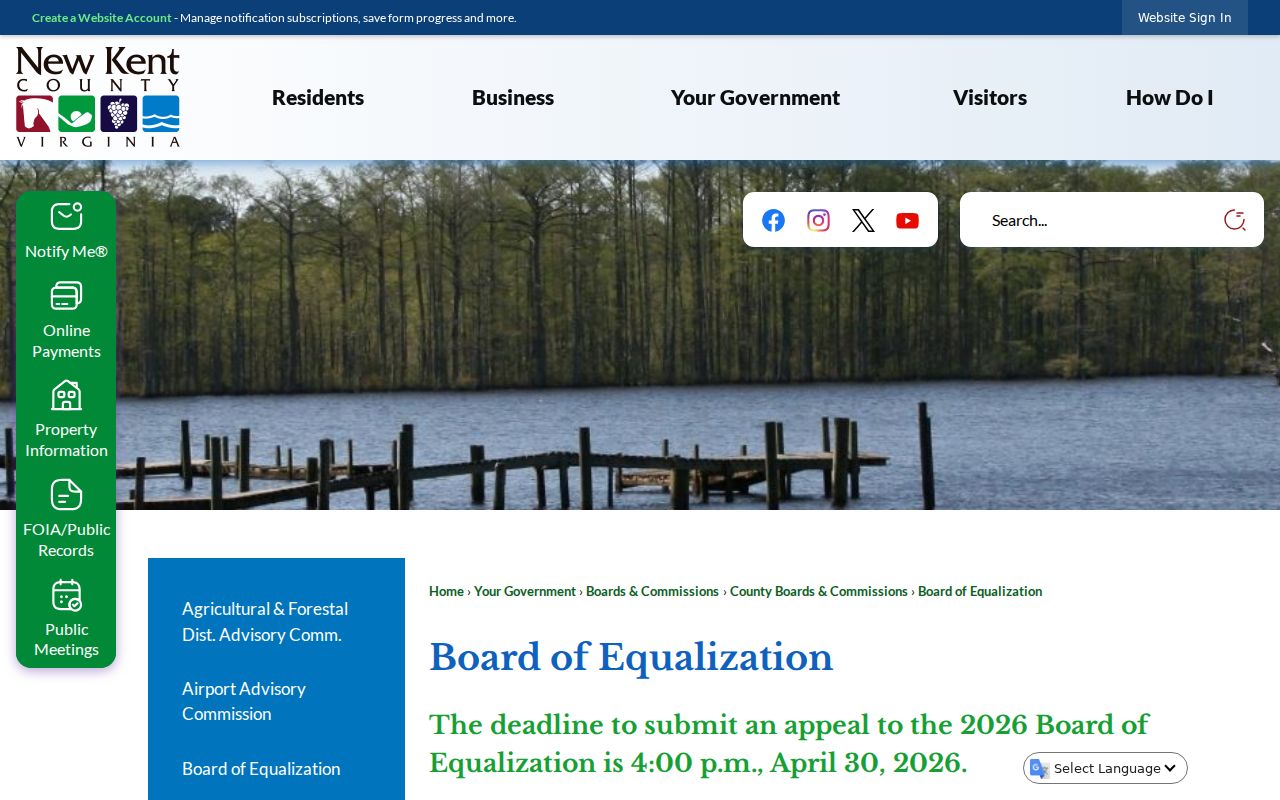
The published Board calendar reflects the 2026 cycle. That deadline is closed now, so verify current dates before any filing.
New Kent Tax Account Numbers Changed in October 2025
New Kent moved to a new billing system. It issued new tax account numbers in October 2025. A prior bill's old account identifier may not work in the quick-payment screen. Create an online account or use Quick Payment with the current number. The portal also shows payment history and tax history. E-check is listed as free; card payments carry a convenience fee.
Assessment values are handled through VGSI. A payment may not appear. A balance may seem wrong, or an older account cannot be found. In any of those cases, call the Treasurer at (804) 966-9615. The courthouse drop box accepts payments by midnight on a due date. Mail payments should name New Kent County. They should include the account number and a contact phone. They should go to the Treasurer's P.O. Box. Use the New Kent Treasurer portal for account access and payment history.
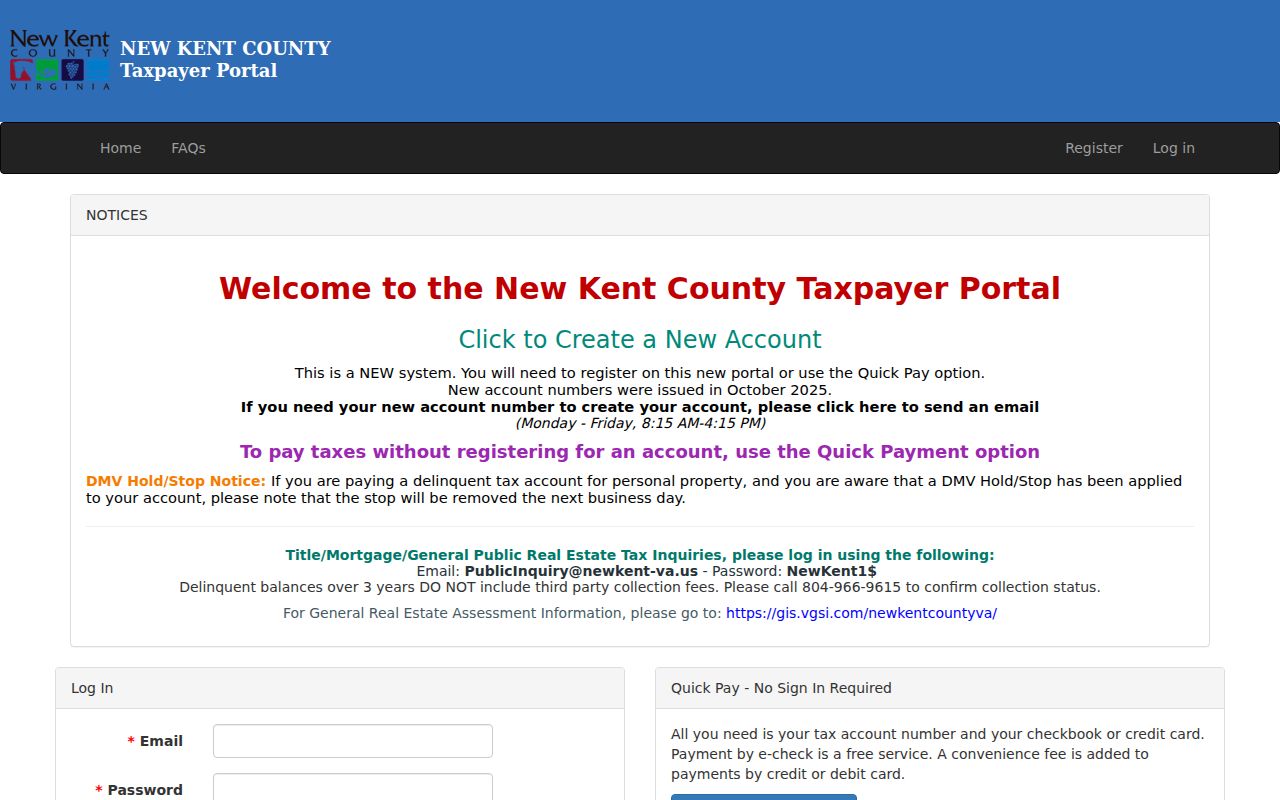
The portal's account-change notice explains the switch. An older billing reference may need matching to a new number.
Separate the New Kent Tax Due Date from Assessment Day
New Kent adopted an ordinance in April 2026. It moved the permanent annual property-tax due date from December 5 to November 1. Tax year 2026 gets a transition rule of its own. Pay the full balance by December 5, 2026 and no penalty applies. Leave a balance on December 6. A 10% penalty then attaches based on the original amount. The county expected bills in early September. It said mortgage and escrow companies were notified.
The new due date changes nothing about assessment day. The reassessment remains effective January 1, 2026. Owners reconciling escrow statements should check the bill year. They should also check the current tax account number and the county's transition notice before assuming an old calendar still controls. For a payment deadline or penalty calculation, confirm directly with the Treasurer. Account-specific adjustments never show up in a general assessment record.
Ask About New Kent Relief and Delinquent Balances
The Commissioner's stated responsibilities include land-use programs, elderly and disabled relief, and disabled-veteran exemptions. New Kent publishes no single countywide eligibility summary or parcel-card label for each program. Ask the Commissioner which application, evidence, and deadline apply to the person and property involved. Relief and land-use classification are assessment-office questions, not quick-payment controls in the Treasurer portal.
For delinquent real-estate balances over three years, New Kent directs callers to (804) 966-9615. The Treasurer's office is at 12007 Courthouse Circle, P.O. Box 109, and generally opens 8:15 a.m.–4:15 p.m. The service window closes at 3:30 p.m. on the last business day of each month. The early close allows staff time for balancing and bank deposits. Online balances may not include every third-party collection cost. Confirm the full amount and payment instructions with the Treasurer. New Kent posts no current tax-sale list or sale calendar. Verify any threatened sale or lien with the Treasurer and Circuit Court Clerk rather than trusting a caller or mailed solicitation.