
What New Kent County Deed Records Establish
Deeds, deeds of trust, releases, easements, and plats all reach the record room through the Circuit Court Clerk's office in New Kent County. A deed is the conveyance itself. It names the grantor and grantee, states the consideration, and carries the execution, recording, and legal-description details of the transfer. A deed of trust or mortgage encumbers the property. A release or satisfaction clears that debt. An easement or right-of-way creates a separate property interest rather than a transfer. The Clerk also holds plats, judgments, wills, fiduciary filings, marriage licenses, and fictitious-name records. Read the instrument type first.
| Deed Type | What It Does | Common Use |
|---|---|---|
| Deed of conveyance | Records a transfer and its legal description | Purchase, gift, or other change in interest |
| Deed of trust | Creates a recorded security instrument tied to the land | Financing; check later assignments and releases |
| Release or satisfaction | Identifies an earlier debt instrument being discharged | Confirm a recorded debt release |
| Executor or administrator deed | Conveys property under estate authority | Probate transfer or authorized estate sale |
| Plat or easement instrument | Describes lot lines, access, or a recorded property right | Subdivision, boundary context, or access review |
Deeds and liens share a property history. A deed conveys. A deed of trust, judgment lien, mechanic's lien, or lis pendens signals an encumbrance or a pending dispute instead. Look past the index name for assignments, amendments, satisfactions, and releases that change what a filing means. No index line settles priority or title.
Use New Kent’s Grantor and Grantee Directions
Every recorded transfer has two parties, so the deed index runs in two directions. A grantor conveys the interest. A grantee receives it. Start with the grantee named on the deed that brought the present owner into the chain of title. That instrument points to the earlier grantor. Search that name as a grantee in the earlier transaction, then compare legal descriptions and parcel clues before stepping back again. New Kent publishes no stated date range for its local online index. Never borrow another county's cutoff dates.
- Locate the current grantee’s deed using the name, parcel clue, or legal description available to you.
- Record the grantor, grantee, deed date, recording reference, and the full property description.
- Search the grantor as a grantee in the prior period and confirm that the described land matches.
- Continue backward until the online index no longer reaches the needed year; then use the Clerk’s records and the Library of Virginia cataloged volumes.
- Grantor
- The party that conveys an interest in the instrument.
- Grantee
- The party to whom the interest is conveyed.
- Chain of title
- The linked sequence of recorded instruments affecting a parcel.
- Book/page or instrument number
- A clerk’s locator for a recorded document; retain the exact reference shown.
Request a Recorded New Kent Deed
New Kent County keeps its deeds and plats at the Circuit Court, where they can be viewed in person. The Clerk's office is at 12001 Courthouse Circle, New Kent, VA 23124, with counter hours of 8:30 a.m. to 4:30 p.m. Call (804) 966-9520 ahead so staff can pull a specific book, prepare a certified copy, or set up image access before your trip. No fee schedule for ordinary or certified copies appears online, and third-party letters or old quotes may not match current charges. Ask the Clerk about current copy fees directly.
Remote research runs through Virginia SRA and COVERS, which may offer a free index where the participating clerk enables it. Images take more. The local Clerk must approve image access. A signed subscription agreement and applicable fees also apply. Mail requests work too. Contact the Clerk for its current request and payment instructions, and include the party names, the approximate recording period, a document reference if known, and a parcel or legal-description clue so staff can find it.
Recorded, not guaranteed. An index entry proves that a document was recorded, not that every interest has been found or that title is clear. Use a title professional for a chain review and the Clerk for an authoritative copy.
New Kent Deed Index Access and Image Limits
Virginia's Secure Remote Access service is often called COVERS. It is the remote route into land-record research. A participating clerk must enable it first. The service makes an index available without charge in some cases. Images are different. They depend on the local Clerk's subscription authorization, a signed agreement, and applicable fees. That distinction matters. Seeing a party name in the index does not guarantee free access. The deed image may not open without payment.
The county publishes no stated start year for its online index. It posts no image price list either. A result may stop at an index line. Record the names and the instrument reference. Then call the Circuit Court Clerk at (804) 966-9520. The clerk's office can explain your options. A public terminal, an in-person inspection, a subscription, or a copy request may fit your need. Another county's SRA dates and charges tell you nothing about New Kent. Read the Virginia SRA land-record access information for the statewide index-versus-image rules.
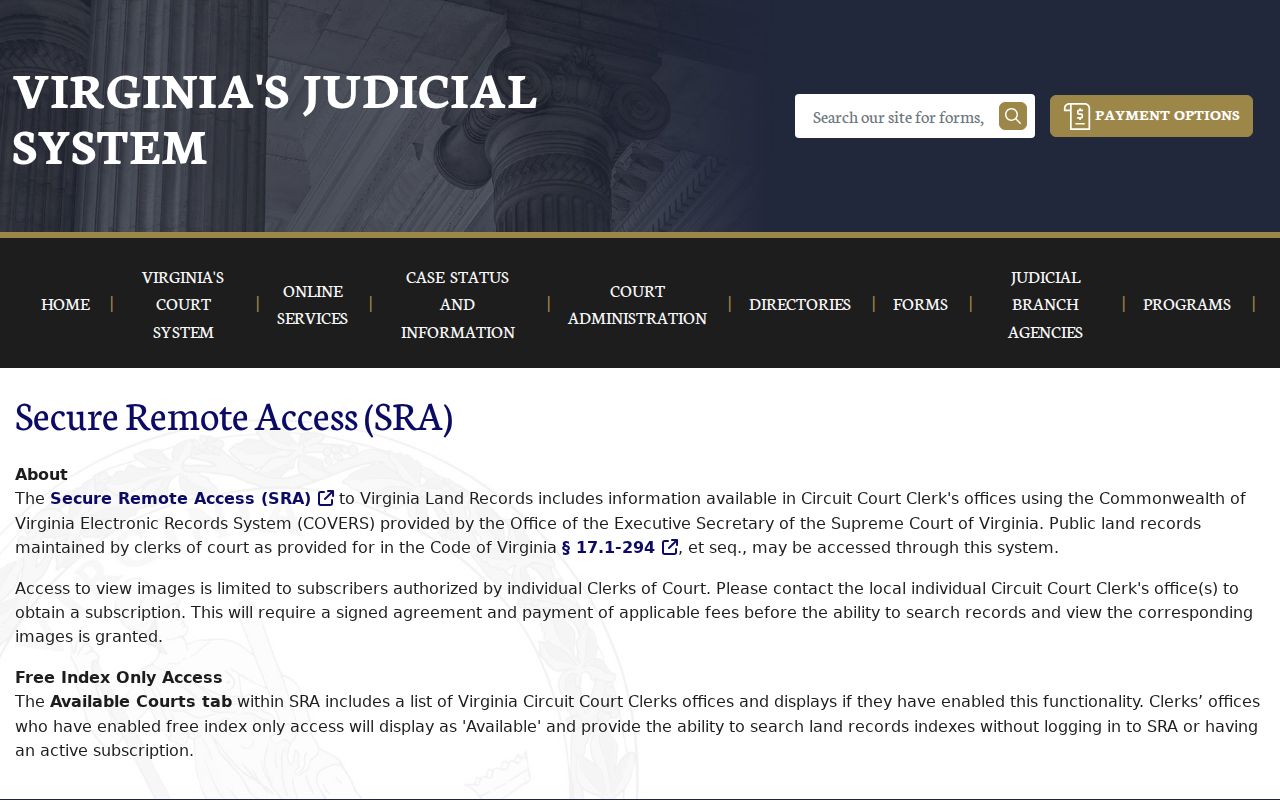
Statewide rules govern access; New Kent sets the fees.
New Kent Deed Books 1 Through 18
The Library of Virginia holds New Kent deed microfilm. The book-by-book run is verified beginning in 1864. Book 1 spans 1864 to 1872. The run continues through Book 18, which covers 1922 to 1923. Separate grantor and grantee indexes cover 1864 to 1912. These dates describe the microfilm collection alone, marking neither a cutoff for the modern SRA site nor the start of New Kent's land history.
An online chain may reach the 1860s or early 1900s. Identify the book and year in the finding aid. Then ask the Library of Virginia or the Circuit Court Clerk how to view the film or the official record. Keep spellings exactly as written. Compare acreage, waterways, neighboring owners, and roads, since older rural deeds may lack street numbers and GPINs. New Kent formed in 1654 from York County. A pre-1864 chain therefore points toward colonial-era sources rather than any assumed records loss.
Consult the Library of Virginia New Kent finding aid before planning a historic deed search.
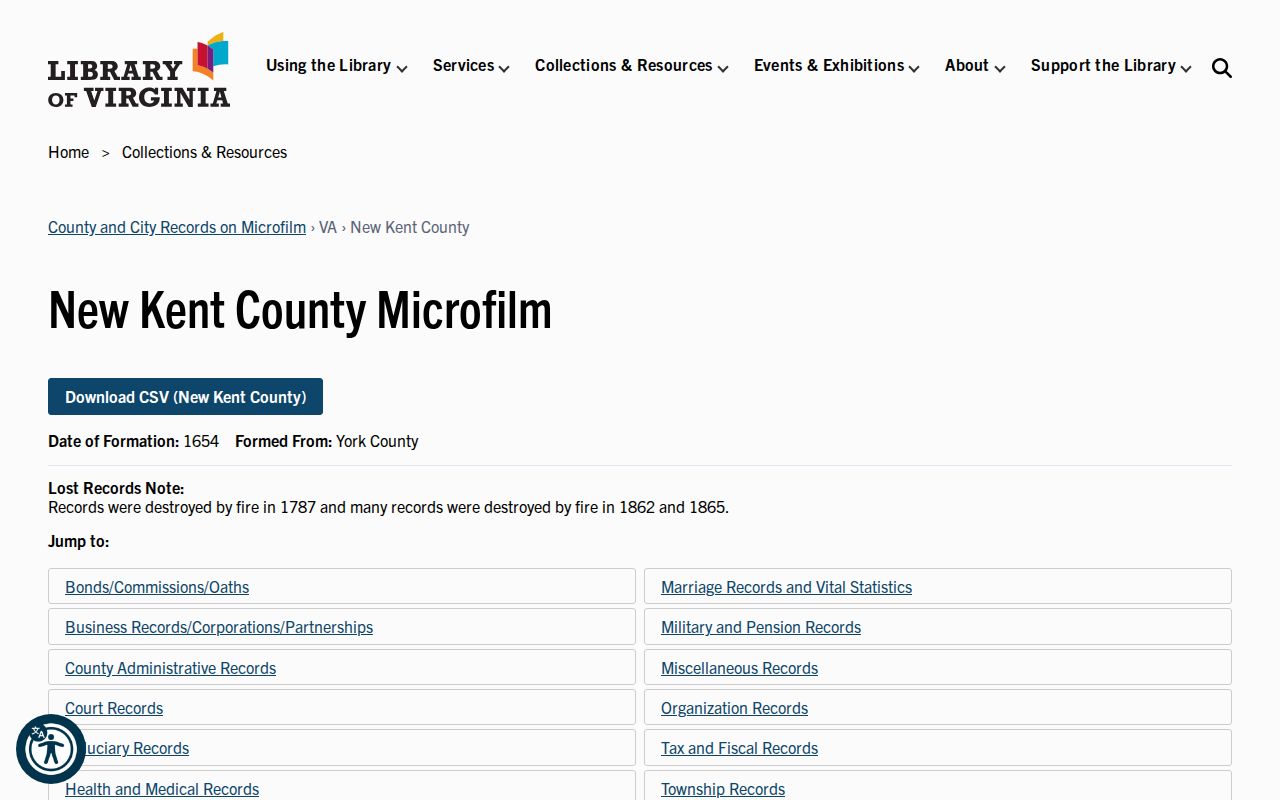
The cataloged deed books and the separate index reels offer a paper path. Working from those volumes and indexes, a researcher can carry a chain of title past what a modern portal search reaches.
Plats Connect New Kent Deeds to the Ground
A deed's legal description can point to a subdivision lot, an older plat, acreage, bearings and distances, a road, a waterway, or an adjoining owner. Plats turn those words into lines on the ground. New Kent's Planning Division reviews subdivision and boundary applications. Once the agencies sign a final plat, the county says the plat and its legal papers may be recorded by the Circuit Court Clerk. A county GIS line can orient a researcher. The recorded plat is the document to compare with the deed, and a licensed survey controls any boundary dispute.
Older plats live elsewhere. The Library of Virginia finding aid lists O.M. Chandler's Plat Book for 1881–1921, processioners' reports and books from 1867 and 1880–1881, a surveyors' book from 1880, and oyster-ground surveys from 1892–1904. These records can explain a change in lot naming. They also help with rural descriptions that predate modern parcel identifiers. For a recent lot split, work from both offices. The Planning file holds the application. The Clerk's recordation holds the resulting legal map.
The county's Circuit Court Clerk page is the contact route for recorded plats and deeds.
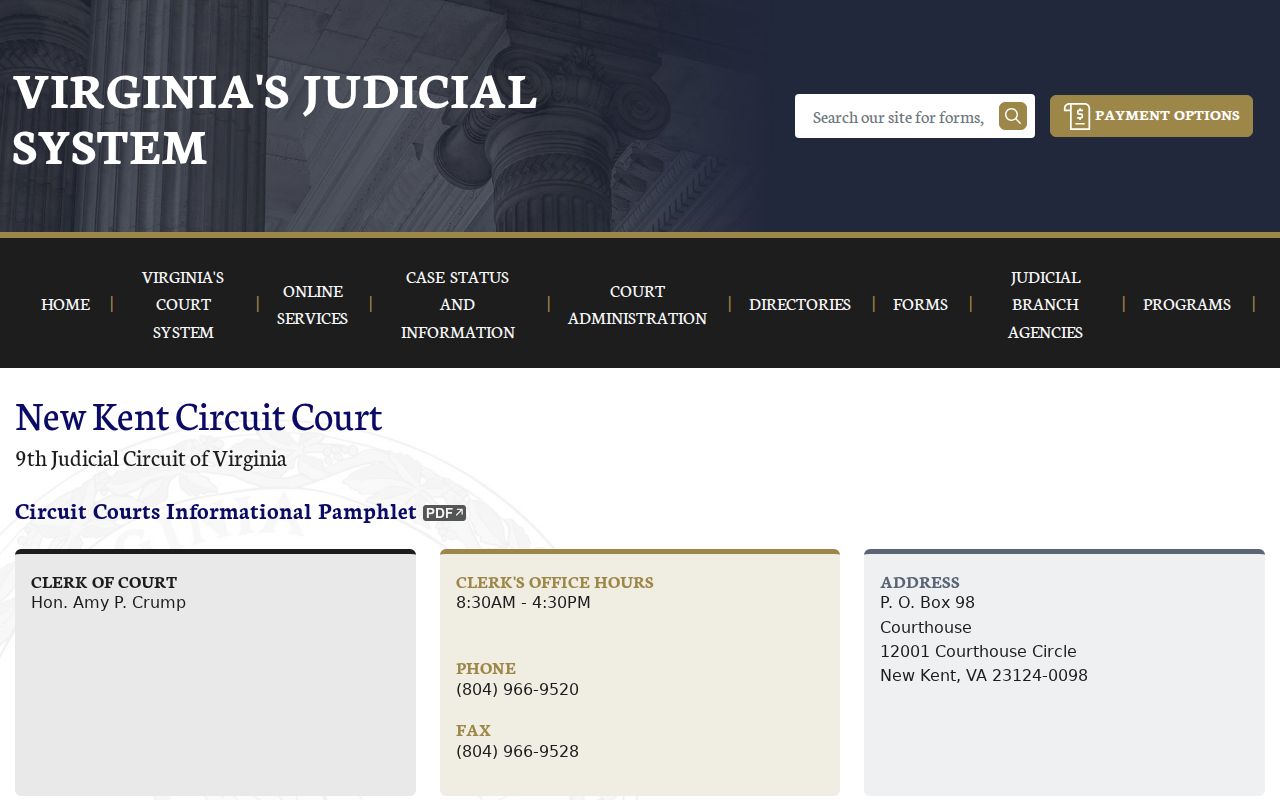
The Clerk's office holds the signed recorded instrument. Confirm inspection and copy procedures there before relying on a map image alone.
Read New Kent Liens and Releases with the Deed
A full property-record review follows more than conveyance deeds. New Kent's Circuit Court land-record set includes deeds of trust, releases, easements, judgments, liens, and lis pendens. A deed of trust identifies a security interest; an assignment may move that interest to another lender; a release or satisfaction should be matched to the original recording reference. A judgment or mechanic's lien may need a separate satisfaction, expiration analysis, or court order. An assessor card does not show every step in this chain.
For a UCC filing or federal tax-lien clue tied to a business or fixture, Virginia SCC CIS is a separate source. It searches by debtor name or file number and offers images for filings since October 1, 2003. A filing there is not automatically proof of a lien against a particular parcel. Compare the debtor, the collateral, and the recording and release details, and consult a title professional where priority matters. The county tax portal can report balances, but real-property lien and sale questions also need confirmation with the Treasurer and Clerk. Delinquent balances over three years go through the Treasurer at (804) 966-9615; the county posts no current tax-sale calendar.
Follow New Kent Estate Transfers into the Land Record
Ownership after a death can travel by many routes. A will, a fiduciary qualification, an inventory, an order of sale, a commissioner's deed, an administrator's deed, or a conveyance by heirs can each move title. New Kent's Circuit Court Clerk keeps the probate and fiduciary records alongside the land record itself. Both halves sit in one office. The Library of Virginia catalog lists fiduciary books from 1865–1930 and a list of fiduciaries for 1850–1870. They can name an executor in older research. A probate file can explain a person's authority. The recorded deed or court order is the link. That instrument is what ties the estate event to the parcel chain, not the will alone.
Vital records help with a death or a relationship. They are not proof of ownership. Virginia sets eligibility and identification requirements for current death, marriage, and divorce certificates. Under Code §32.1-271, the public opening periods are 25 years for death, marriage, divorce, and annulment records and 100 years for births.
A sale chain can look stalled at a deceased owner. Search the Clerk's estate records first, then return to the land index for the deed or order that conveyed the parcel.
Ask the New Kent Clerk for the Right Copy Route
New Kent's Circuit Court Clerk is Amy P. Crump. The office sits at 12001 Courthouse Circle, New Kent, VA 23124, with mail to P.O. Box 98, telephone (804) 966-9520, and fax (804) 966-9528. Listed hours run 8:30 a.m. to 4:30 p.m. The Clerk records deeds, plats, judgments, wills, fiduciary and probate filings, marriage licenses, and fictitious names. Calling ahead saves a trip. Have the names, an approximate date, a legal description, a book/page or instrument reference, and whether you need an inspection copy or a certified document.
New Kent publishes no current fee schedule for ordinary and certified copies. SRA image access is set by the individual clerk. Ask for the current fees and payment steps before mailing a request. VFOIA is not the ordinary route here. Code §2.2-3703(A)(6) excludes court-clerk records. Access follows court and clerk procedures instead. A current official Clerk contact listing is the safest way to confirm hours and request details.